
Four players · A new decision on every tee
How to play Wolf in golf
Wolf is a four-player game in which one golfer chooses a partner for the hole or takes on the other three alone. The role rotates. The version below is Turnt’s: the Wolf tees first, partner choices are immediate, and net best ball decides the hole.
Turnt Golf game guides · Examples are illustrative, not player results.
Choose the drive in front of you—not the one you passed
Set the player order before starting. On each hole, the Wolf hits first and then watches the other players tee off one at a time. After a player hits, the Wolf must choose that player immediately or pass. Once the next player hits, the previous option is gone.
Choose a partner and the hole becomes two against two. Pass on everyone and it becomes Lone Wolf, one against three. Blind Wolf is a different commitment: in Turnt it must be declared before the Wolf hits their own tee shot.
Beat the other side’s best net score
Every golfer plays their own ball. With partners, compare the lower net score from each pair. Alone, the Wolf must beat the lowest net score among all three opponents—not their average and not their combined strokes.
Illustrative hole: Alex is Wolf and selects Sam. Their net scores are 5 and 4; Jordan and Riley each have net 5. Alex and Sam win because their best ball is 4 against 5. If Alex had gone alone with that same net 5, Sam’s net 4 would have beaten Alex.
What 1×, 2× and 3× actually mean in Turnt
The multiplier applies against each opponent, not just once to the winning side. A partnered winner beats two opponents. A solo Wolf beats three. That is why a 2× Lone Wolf win produces six points for the Wolf, not two.
These are illustrative net point changes for a decided hole. Reverse the signs if the named side loses. Tied best-ball scores push: everyone gets zero and nothing carries to the next hole.
| Decision | Matchup | Winner change | Loser change |
|---|---|---|---|
| Partner · 1× | 2 versus 2 | +2 each | −2 each |
| Lone Wolf · 2× | 1 versus 3 | Wolf +6 | Each opponent −2 |
| Blind Wolf · 3× | 1 versus 3 | Wolf +9 | Each opponent −3 |
Rotation and the last two holes
Turnt rotates through the four-player order for holes 1–16. On holes 17 and 18, the trailing player gets the Wolf role, based on the scored results so far. Ties are resolved by the game’s rotation tie-break.
Wolf has many house-rule versions, including different tee orders and multipliers. Agree on the version before playing. Do not import another group’s scoring table into Turnt and assume it will match.
See it in Turnt
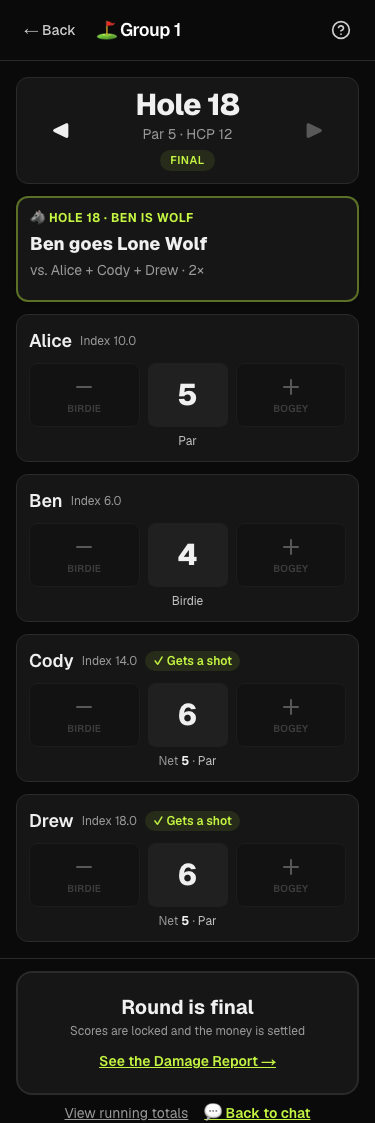
Actual app capture using fictional demo players. Turnt tracks scores and results; it does not process wagers or payments.
Common questions
Does Turnt support three-player Wolf?
The Wolf version described here requires exactly four players. Choose another format if your group size changes.
Is best ball a scramble?
No. Each golfer plays their own ball through the hole. The side uses its lowest net score; players do not all move to the best shot.
Can I wait until everyone hits to choose a partner?
Not in Turnt’s described version. Take a player immediately after their tee shot or pass. You cannot go back after the next player hits.
Find your next game
Further reading: GolfApp’s Wolf guide shows why house-rule variants matter. Other publishers may describe different rules or product settings. Turnt-specific explanations above describe Turnt’s version.